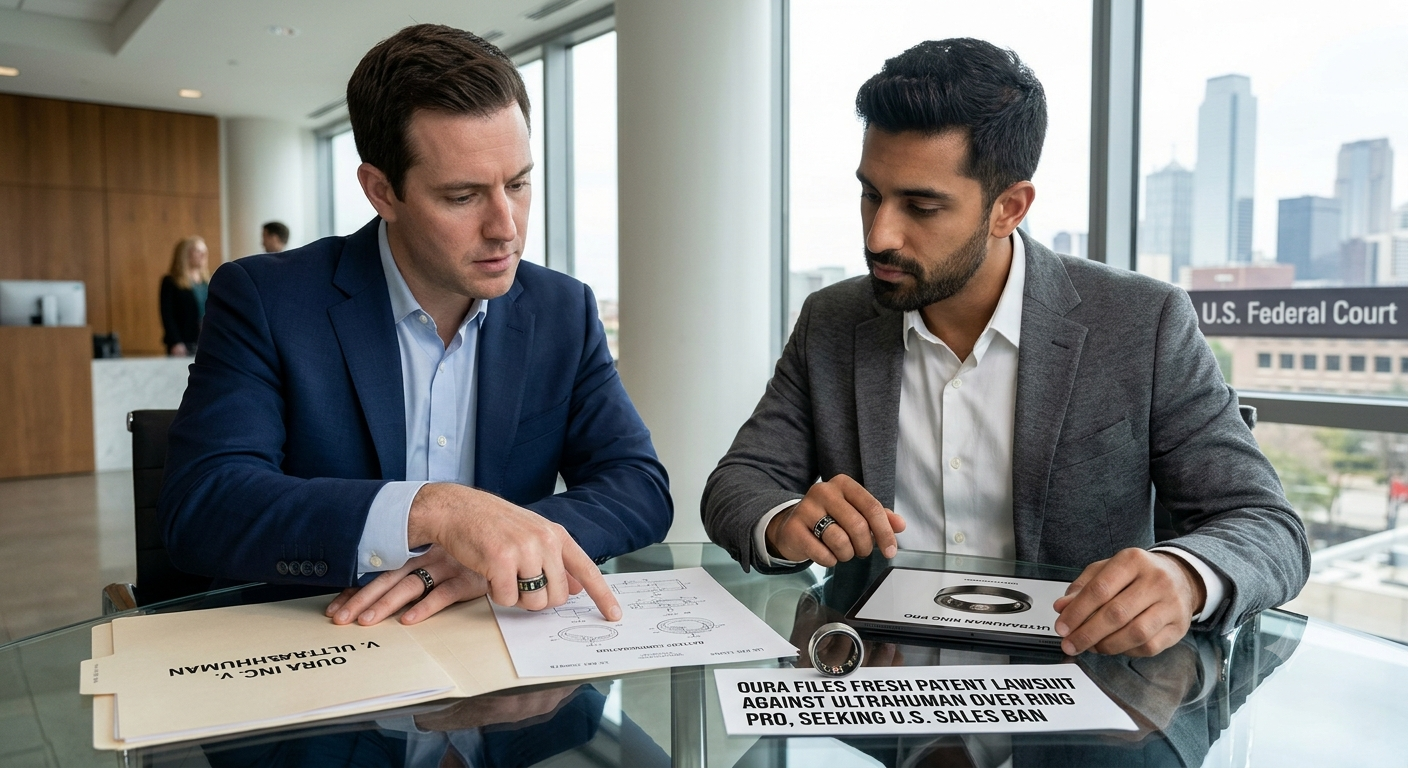
A fresh lawsuit targeting Ultrahuman’s Ring Pro could complicate the company’s U.S. expansion, as competition intensifies in the rapidly growing wearable technology market.
The competition in the smart ring industry is increasingly moving beyond product features and health tracking into legal disputes over intellectual property. Oura, a leading smart ring manufacturer, has filed another lawsuit against Indian wearable technology company Ultrahuman, seeking to restrict U.S. sales of its latest Ring Pro device.
The complaint, filed in a federal court in Texas on October 22, 2026, alleges that Ultrahuman’s redesigned smart ring infringes two Oura patents covering aspects of its design and internal hardware. Oura is seeking financial damages and a permanent injunction that would prevent further sales of the disputed product.
The case adds another chapter to a dispute that has already affected Ultrahuman’s ability to compete in the American market.
Why the Ring Pro Is Facing Legal Challenges
Ultrahuman introduced the Ring Pro in February 2026 as part of its efforts to strengthen its position in the smart ring market. In March, the redesigned device received a favorable determination from U.S. Customs and Border Protection, allowing the company to resume its American sales following restrictions on its earlier Ring Air product.
Those earlier restrictions followed a patent infringement ruling secured by Oura through the U.S. International Trade Commission in 2025.
However, Oura argues that the customs decision addressed a specific patent involved in the previous dispute and did not resolve the two additional patents cited in its latest complaint. One of these patents was issued on October 20, just two days before the lawsuit was filed. It covers a smart ring configuration incorporating components such as a curved battery, circuit board, magnets, and sensors.
The complaint also names SVTronics, a Texas-based electronics manufacturer that Oura alleges produces the Ring Pro at its facility in Plano. Oura claims both companies are responsible for infringing its intellectual property through manufacturing, importing, and selling the device.
Ultrahuman Plans to Defend Its Product
Ultrahuman has rejected the allegations and expressed confidence in its latest smart ring.
Chief Executive Officer Mohit Kumar stated that the company intends to challenge the claims through the appropriate legal process. He also emphasized that no court order currently prevents Ring Pro sales in the United States.
The distinction is important for consumers and retailers because the lawsuit does not, by itself, establish that infringement has occurred or automatically prohibit the product’s sale.
The outcome could nevertheless influence Ultrahuman’s expansion plans, particularly if the court eventually grants the restrictions Oura is requesting.
A Wider Fight Over Smart Ring Patents
Oura’s dispute with Ultrahuman is part of a broader pattern of patent enforcement across the wearable technology industry. The company has also pursued legal claims involving other smart ring makers, including Samsung, RingConn, Circular, and Zepp Health.
Some competing manufacturers have entered licensing agreements with Oura, allowing them to continue selling their products in exchange for royalty payments.
These disputes illustrate how intellectual property rights can become a strategic consideration in a market where companies compete through hardware design, miniaturized sensors, battery technology, and health-monitoring capabilities.
Growing Market, Increasing Competition
Despite the legal uncertainty, the smart ring category continues to attract investment and product development. Research firm IDC expects worldwide shipments to increase by 12.8% in 2026 to approximately 4.9 million units, with the market potentially reaching 6.3 million shipments by 2030.
Oura continues to expand its health and fitness tracking features, while Ultrahuman is exploring opportunities beyond traditional wellness monitoring.
In September 2026, Ultrahuman raised $70 million from investors, including Qualcomm Ventures and Labcorp, at a reported valuation of approximately $365 million. Its collaboration with Qualcomm also points toward potential smart rings capable of supporting more on-device software and applications.
Meanwhile, Oura recently paused plans for a proposed $2.2 billion initial public offering, citing uncertainty in market conditions.
What Happens Next?
The latest lawsuit highlights the challenges facing companies attempting to scale in a competitive hardware market. Patent disputes can influence product availability, manufacturing arrangements, licensing costs, and investor confidence.
For Ultrahuman, defending the Ring Pro will be important to maintaining its U.S. momentum. For Oura, the case represents another effort to protect its patented technology as more competitors enter the category.
Ultimately, the legal proceedings may help determine how these companies compete in the United States. Until a court reaches a decision, the allegations remain disputed, and the future impact on Ring Pro sales remains uncertain.