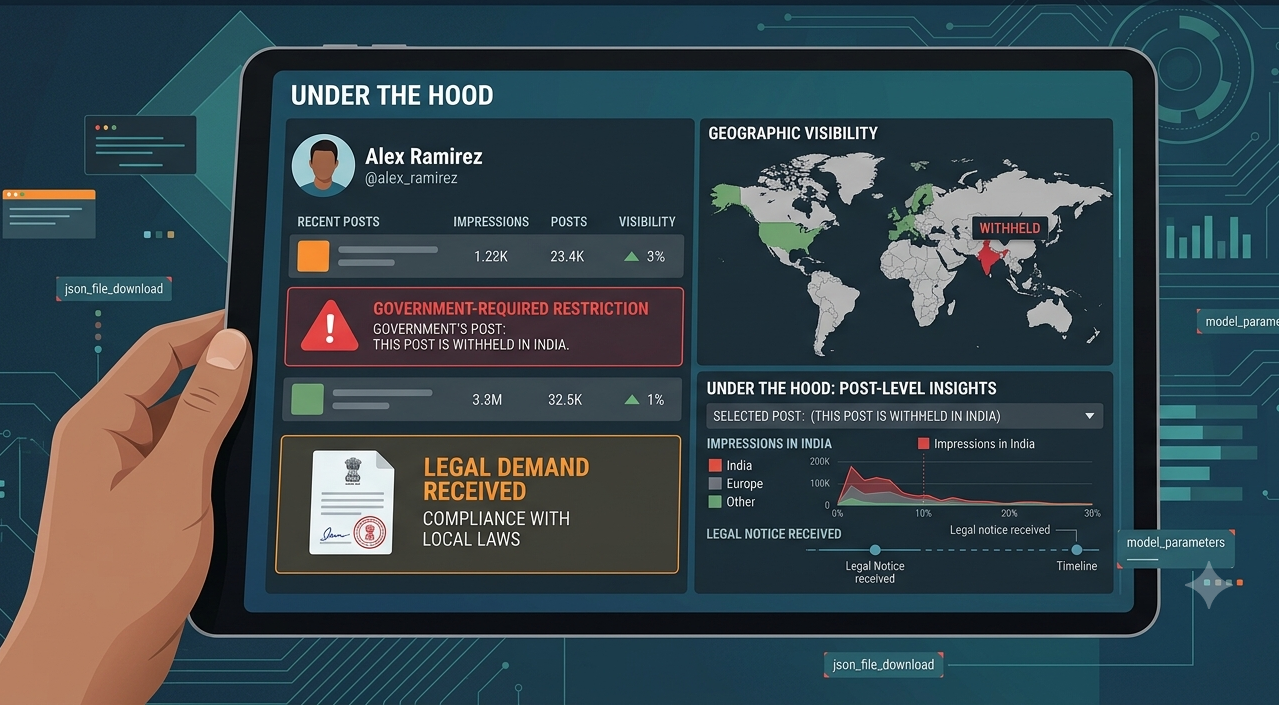
X is giving users more information about why their posts sometimes receive less visibility — particularly when government requirements are involved.
The social network is expanding its “Under the Hood” transparency feature to show when an account or individual post has been limited because X is complying with local laws or government-required content restrictions.
The change addresses a long-running source of confusion on social platforms: users may notice a sudden drop in reach without clearly understanding whether it resulted from the platform’s ranking system, moderation policies, or a legal requirement.
Now, X wants to provide more visibility into what happened.
Users Can See Government-Required Restrictions
The expanded transparency system can indicate when posts have been downranked or otherwise restricted because of government-required filtering.
Users will also be able to see which posts were withheld within a particular country following a legal demand and identify the country associated with the request.
That’s more granular than the traditional approach used by many technology platforms.
Companies often publish transparency reports showing aggregate numbers of government requests, but those reports don’t necessarily explain what happened to an individual user’s content.
X’s approach brings some of that information down to the account and post level.
“Under the Hood” Explains Your Account’s Reach
X originally introduced Under the Hood in August as part of a broader effort to make its moderation and recommendation systems more transparent.
Users who have published at least 10 posts during a month can access aggregated information about their account and download it as a JSON file.
The data can show whether labels have been applied to an account or its posts that may affect visibility.
For people unfamiliar with JSON, the file can also be provided to an AI assistant for help interpreting the information.
The latest update adds government-related restrictions to that dataset.
As a result, users should have more information for distinguishing between platform moderation and restrictions resulting from legal requirements in specific jurisdictions.
Why Governments Ask Platforms to Restrict Content
Governments can seek restrictions on online content for many reasons.
Depending on the jurisdiction, requests may involve laws covering hate speech, terrorism-related material, election rules, or other categories of content considered unlawful under local legislation.
X says content can be withheld in a particular jurisdiction when it receives a valid legal demand or determines that local law requires restriction.
The subject remains politically contested. Governments may argue that restrictions enforce national law or protect public safety, while civil-liberties and free-expression organizations sometimes argue that particular laws or demands can be used to suppress lawful criticism or political dissent.
The new transparency feature doesn’t resolve those disputes, but it could give affected users more information about why their content was restricted.
X Is Opening More of Its Recommendation System
The update is part of a wider transparency initiative at X.
The company has also released information about the technology behind its “For You” recommendation system and open-sourced additional parts of its codebase.
That material includes details about filtering, model configuration, ranking systems, and some of the parameters used to determine the relative importance of different signals.
Those signals influence which posts are selected and prioritized in users’ feeds.
For creators and other users, greater visibility into those systems could make it easier to understand why certain content travels widely while other posts receive limited distribution.
Transparency Doesn’t Eliminate the Debate
Showing users why their content has been restricted is different from deciding whether a restriction was appropriate.
Questions about online speech involve governments, courts, technology companies, local laws, platform policies, and users — often with competing interests.
What X’s latest change can provide is additional information.
Instead of simply noticing that a post has disappeared from a country or experienced reduced distribution, users may have more evidence about the reason behind the action.
In an era when algorithms and legal requirements can both determine who sees what online, transparency about those decisions is becoming almost as important as the decisions themselves.