
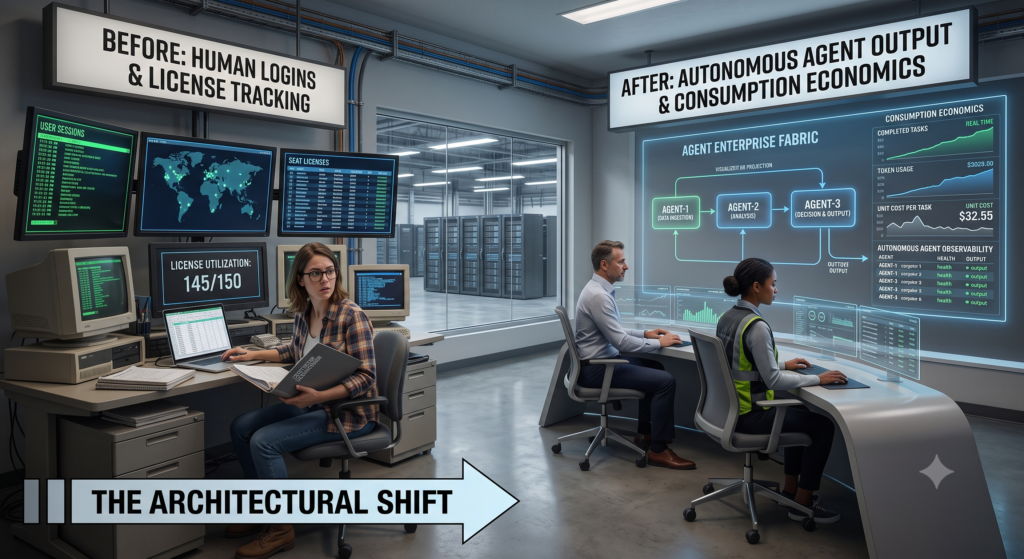
The traditional per-seat subscription pricing model that powered the cloud computing boom over the last two decades is undergoing a terminal decline. For twenty years, business-to-business software valuations, go-to-market strategies, and enterprise IT budgets were built on a simple, predictable metric: human headcount. If an enterprise hired fifty new financial analysts, they bought fifty more licenses of their ERP, data visualization, and spreadsheet software. Today, as autonomous artificial intelligence agents begin executing the workload of entire departments, this foundational economic equation has broken down. When a single AI agent can process, reconcile, and finalize thousands of vendor invoices without human intervention, charging by the user license is no longer just outdated—it is an existential threat to vendor revenue.
We are witnessing a structural reconfiguration of the B2B technology sector that extends far beyond software capabilities into the very unit economics of enterprise commerce. Software companies that continue to sell digital shovels to human workers are being rapidly displaced by platforms that sell completed outcomes directly to the enterprise. This transition from Software-as-a-Workflow to Software-as-an-Outcome requires B2B executives to fundamentally rethink their product architectures, pricing models, data infrastructure, and customer retention strategies.
The Collapse of Per-User Economics and the Rise of Value-Based Pricing
To understand why the per-seat SaaS model is collapsing, one must look at the operational mechanics of modern enterprise AI. Consider a mid-sized B2B logistics firm that previously employed forty customer support representatives to handle billing disputes, shipment tracking requests, and customs documentation. They utilized a specialized enterprise helpdesk platform, paying roughly $150 per user, per month—generating $72,000 in annual recurring revenue (ARR) for the software vendor.
With the deployment of an autonomous AI customer service agent integrated directly into the company’s enterprise knowledge graph, eighty percent of incoming tier-1 and tier-2 support tickets are now resolved instantly without human intervention. The logistics firm needs only eight human supervisors to manage exceptions and edge cases. Under the legacy per-seat pricing model, the software vendor’s reward for enabling this massive productivity leap is an 80% loss in revenue, as their ARR drops from $72,000 to $14,400.
This structural paradox is forcing a rapid industry-wide migration toward outcome-based, consumption-based, and hybrid pricing models. Modern B2B technology vendors are pivoting to charge for:
- Work Units Executed: Pricing based on concrete operational outputs, such as the number of contracts autonomously generated and reviewed, invoices matched and paid, or cybersecurity threats neutralized.
- Compute and Inference Consumption: Mirroring cloud infrastructure economics by billing based on the computational resources and model tokens required to power dynamic, agentic workflows.
- Shared Value Realization: Structuring enterprise contracts where software vendors take a fractional percentage of the direct financial upside generated by the AI platform, such as supply chain waste reduction or working capital optimization.
Transitioning a B2B organization from seat-based to consumption-based billing is an operational surgery that impacts every internal department. Sales compensation models must shift from closing large, static contract values up-front to driving ongoing platform utilization. Customer Success teams can no longer focus purely on login frequency; their primary KPI must be the continuous velocity of automated business value delivered to the client’s bottom line.
The Architectural Pivot: Why B2B Enterprises Are Abandoning Giant LLMs for Domain-Specific SLMs
During the initial wave of enterprise AI adoption, B2B technology strategies were dominated by a monolithic approach: licensing massive, trillion-parameter Large Language Models (LLMs) from generalist AI providers and attempting to mold them to fit niche enterprise use cases. Two years into deployment, chief technology officers have realized that utilizing an LLM trained on the entirety of the public internet to parse proprietary, highly technical B2B workflows is computationally wasteful, financially unsustainable, and security-deficient.
The competitive edge in B2B engineering has shifted decisively toward Small Language Models (SLMs) and domain-specific architectures. These compact, highly optimized neural networks—often containing between one billion and seven billion parameters—are custom-trained or aggressively fine-tuned on specialized enterprise datasets, such as pharmaceutical compliance documentation, aerospace engineering schematics, or cross-border tax regulations.
The Strategic Advantages of Small Language Models in B2B:
- Dramatically Reduced Inference Costs: Running continuous real-time AI workflows on massive public models creates an unsustainable FinOps burden. SLMs require a fraction of the computational power, allowing B2B software vendors to deploy continuous, automated reasoning without destroying their gross margins.
- Ultra-Low Latency Execution: In mission-critical B2B environments—such as high-frequency financial trading, industrial IoT edge monitoring, or real-time supply chain routing—milliseconds matter. Compact models can be deployed locally on enterprise edge servers, delivering instantaneous responses that massive cloud-based LLMs cannot match.
- Data Sovereignty and Zero-Trust Security: Enterprise clients in regulated industries like defense, healthcare, and finance refuse to send proprietary data over public APIs. SLMs are small enough to be deployed completely within a client’s virtual private cloud (VPC) or on-premise infrastructure, ensuring absolute data privacy and compliance with international data sovereignty laws.
- Elimination of Generalist Hallucination: Because domain-specific SLMs are trained exclusively on curated, high-fidelity industry data rather than scraped web text, they exhibit vastly lower hallucination rates when performing specialized technical analysis.
The winning B2B software architectures of the next decade will not rely on a single, monolithic AI brain. Instead, they are being built as modular orchestrations of specialized SLMs—an “assembly of experts” where an intent-routing model delegates tasks to specialized financial, legal, or technical models working in synchronized harmony.
Reinventing Go-to-Market: Selling to Autonomous Buyers and Machine Customers
As AI transforms the internal operations of software companies, it is simultaneously reshaping how B2B buyers discover, evaluate, and purchase technology. Traditional B2B marketing and sales strategies—reliant on outbound cold calling, gated PDF whitepapers, and prolonged sales discovery calls—are collapsing under the weight of buyer automation.
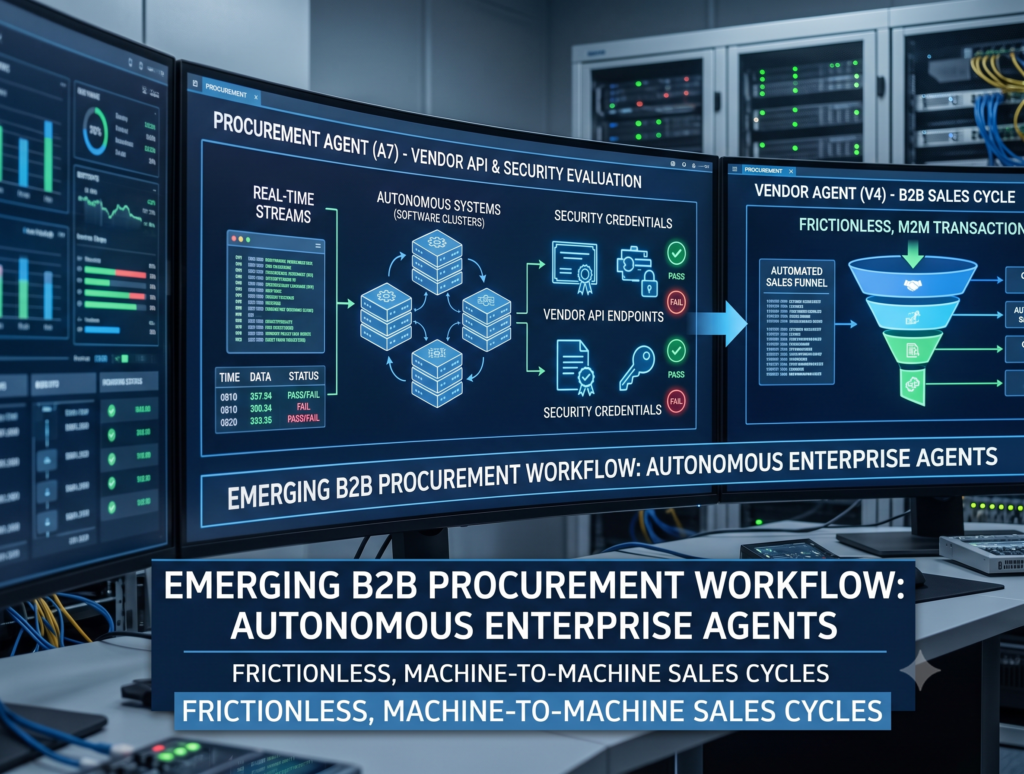
We have entered the era of the Machine Consumer. Gartner defines machine consumers as non-human actors—autonomous software agents and algorithms—capable of purchasing goods and services independently. In the B2B technology ecosystem, this is no longer a futuristic concept; it is an active operational reality. Enterprise procurement teams are deploying automated buyer bots that continuously sweep the market, evaluate vendor APIs, analyze public security audits, and initiate software trials without ever speaking to a human sales representative.
Adapting GTM Strategies for Machine-Readable Commerce:
To thrive in an environment where your first point of contact is an AI algorithm, B2B organizations must overhaul their digital footprint:
Transparent, Machine-Readable Documentation
When an autonomous procurement agent evaluates your software platform against a competitor, it does not watch your marketing webinars. It scrapes your API documentation, ingests your developer changelogs, and evaluates your published SOC-2 security certifications. If your technical documentation is gated behind a sales form or written in vague marketing speak, the automated buyer scores your platform poorly and eliminates it from the vendor evaluation list.
Automated, Frictionless Proof-of-Concept (POC) Sandboxes
Modern enterprise engineers and autonomous agents demand immediate proof of value. B2B vendors must replace the traditional “Schedule a Demo” button with self-provisioning, sandbox environments. These automated testbeds allow prospective clients—and their evaluative AI bots—to safely ingest synthetic data, test API response times, and verify security protocols within minutes rather than weeks.
Predictive GTM and Intent-Driven Outreach
While machines handle evaluation, high-level enterprise software deals still require human consensus. Modern AI-driven revenue teams utilize predictive analytics to monitor dark social channels, developer forums, and GitHub repositories to identify exact moments when a prospective company’s engineering team is struggling with a technical roadblock. Sales outreach is no longer a generic pitch; it is a precisely timed, automated technical briefing sent directly to the Chief Technology Officer, offering a pre-configured solution to the exact problem their developers were debating online an hour earlier.
The AI Governance Mandate: From Compliance Checkbox to Competitive Advantage
As AI architectures deeply integrate into critical enterprise operations, the corporate conversation surrounding data governance, safety, and ethical AI has shifted from a defensive legal compliance task to a core commercial differentiator. In the current B2B landscape, an enterprise will simply refuse to sign a six-figure software contract if the vendor cannot mathematically prove how data is ingested, isolated, and forgotten.
The most successful B2B technology providers are weaponizing their governance architectures to win market share from slower, legacy competitors. This requires mastering three critical domains of AI governance:
Cryptographic Data Lineage and Provenance
Enterprise customers must know the origin of every piece of data used to train or fine-tune an AI model. B2B vendors are implementing immutable data lineage tracking—often utilizing ledger-backed databases—to create an unshakeable audit trail. When an AI agent generates a financial recommendation or modifies an enterprise supply chain route, the software can instantly display the exact data points, historical records, and policy weights that influenced that specific decision.
Dynamic Zero-Trust Model Isolation
In multi-tenant SaaS environments, the greatest fear of any Chief Information Security Officer (CISO) is data leakage—the nightmare scenario where Company A’s proprietary product roadmaps inadvertently influence the AI model outputs generated for Company B (their direct competitor). Modern B2B architectures must implement dynamic zero-trust model isolation. Through techniques such as Retrieval-Augmented Generation (RAG) combined with strict, identity-aware vector database partitioning, vendors can guarantee that an AI model only has access to the specific data permissions of the authenticated user invoking the query.
Algorithmic Explainability and automated Red-Teaming
When an autonomous system makes a high-stakes business mistake, “the neural network is a black box” is no longer an acceptable legal or operational defense. Enterprise B2B software must incorporate automated explainability layers that translate complex algorithmic weights into plain-language business logic. Furthermore, leading vendors are continuously subjecting their own systems to automated adversarial red-teaming—deploying specialized attacker AI models designed to probe their enterprise software for security loopholes, prompt injection vulnerabilities, and logic flaws 24 hours a day, 7 days a week.
An Executive Roadmap for Surviving the SaaS Re-Architecture
The transition to AI-native, outcome-based B2B technology is not a gradual evolution; it is an abrupt structural shift that will create a massive divide between companies that adapt their underlying economics and those that remain trapped in legacy software paradigms. For executive leadership, engineering VPs, and product strategists, navigating this transformation requires immediate, decisive execution across five strategic dimensions:
- Conduct an Immediate Unit-Economics Audit of Your Product Stack: Analyze your current pricing model against the trajectory of AI automation. If your revenue is directly tied to human user counts in an industry where AI is actively reducing headcount, begin architecting a migration path toward hybrid, usage-based, or value-realization pricing immediately.
- Deconstruct Monolithic AI Strategies in Favor of Modular SLMs: Stop burning capital trying to fine-tune massive generalist LLMs for specialized enterprise tasks. Audit your core product features and replace generalist API calls with compact, domain-specific Small Language Models deployed locally within secure edge or VPC environments to drastically reduce FinOps overhead and latency.
- Optimizing Your Digital Footprint for Machine Consumers: Treat external AI agents and automated procurement algorithms as a primary customer persona. Ensure your API documentation is exhaustive, transparent, and machine-readable. Build self-provisioning, automated sandbox environments that allow enterprise buyer bots to test and validate your software without sales friction.
- Transform Customer Success from Reactive Support to Predictive Value Orchestration: Eliminate manual health-score tracking. Deploy continuous monitoring agents that ingest product usage telemetry to predict customer churn risks before they manifest. Shift your Customer Success compensation metrics away from software usage toward the verified financial return on investment delivered to the client.
- Weaponize Security and Governance as a Primary Sales Enablement Tool: Stop treating SOC-2 and data privacy compliance as backend administrative tasks. Build user-facing explainability dashboards, real-time data lineage trackers, and transparent zero-trust architecture documentation directly into your sales collateral to turn enterprise data anxiety into your greatest competitive advantage.
The B2B technology sector is shedding the skin of its initial AI experimentation phase and stepping into a mature, economically rigorous era. The winners of this next decade will not be defined by who has the flashiest generative chat interface or the largest marketing budget. Domination will belong to the organizations that successfully decouple their revenue from human headcount, engineer highly efficient and secure domain-specific AI architectures, and build enterprise platforms that deliver verifiable, autonomous business outcomes at scale. The software seat is dead; long live the software outcome.