For the better part of a decade, enterprise technology leaders were told that digital transformation was about “going digital.” Then came the era of generative AI experimentation—a chaotic sprint to embed conversational bots, automated summarizers, and prompt-based software layers onto decades-old enterprise stacks.
Now, the enterprise AI conversation has fundamentally shifted.
The era of novelty is officially over. Modern enterprise decision-makers—from CIOs and Chief Revenue Officers to Procurement Leaders—are no longer asking what artificial intelligence can do in theory. Instead, they are measuring what autonomous systems actually deliver in terms of unit economics, contract cycle acceleration, customer retention, and bottom-line efficiency.
We have entered the age of Intelligent Infrastructure and Agentic Operations. B2B organizations are moving away from isolated point solutions and prompt-driven copilots toward autonomous AI agents, unified data layers, and self-assembling software workflows.
This comprehensive guide breaks down the core structural trends reshaping B2B technology, how market leaders are deploying autonomous workflows, and how your organization can build a durable foundation to stay competitive.
1. The Death of Point-Solution Software and the Rise of Agentic AI
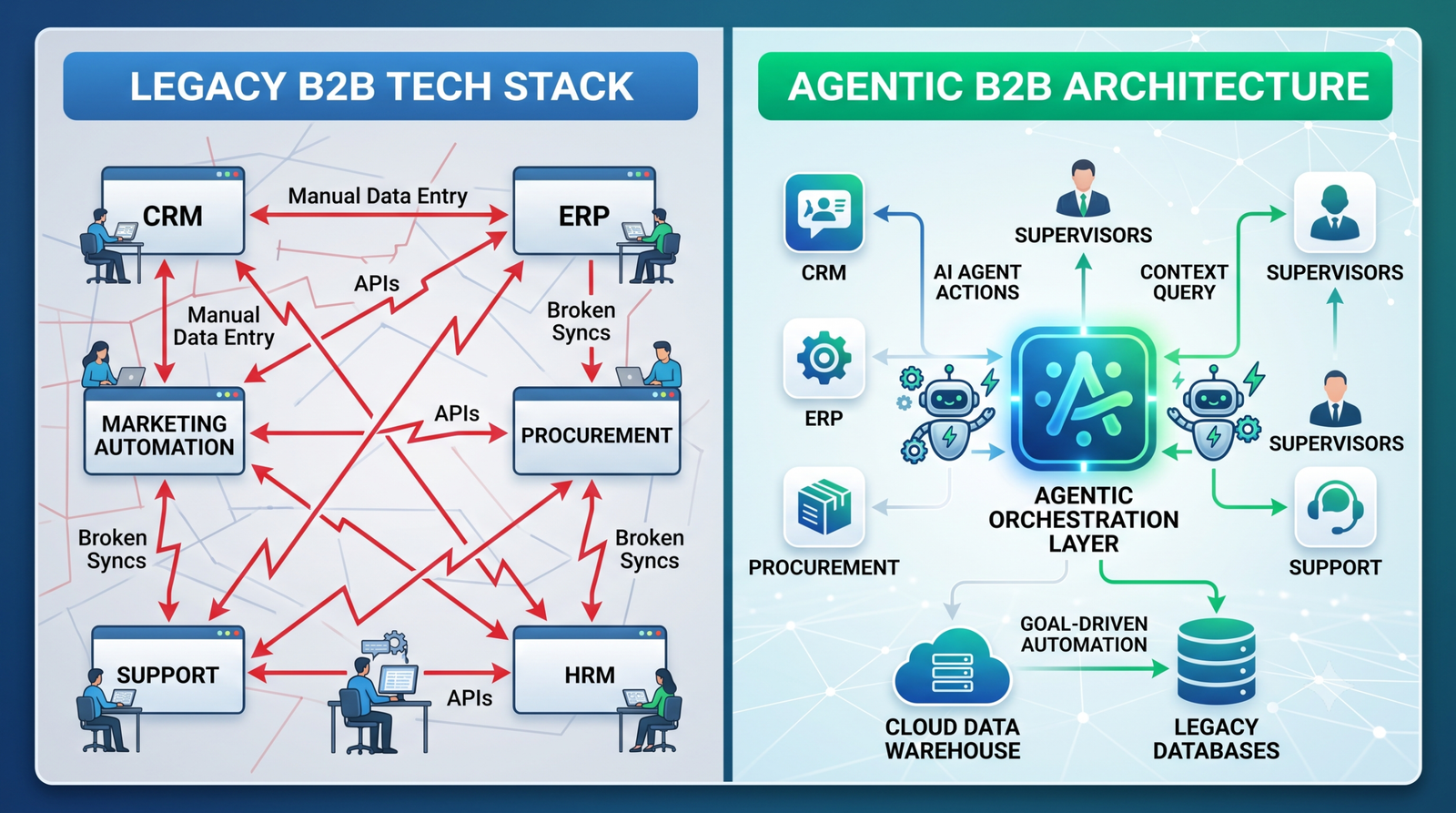
For years, B2B enterprise architecture suffered from massive application sprawl. A typical mid-market to enterprise firm operates on dozens—sometimes hundreds—of disparate SaaS licenses across sales, marketing, ERP, supply chain, and HR systems. Employees spent hours acting as human data pipelines, copying context from CRM systems into ERP platforms, manually verifying inventory, and updating contract terms.
Traditional automation tools relied on rigid, rule-based logic (if this happens, do that). When an edge case occurred or data formats changed slightly, the workflow broke down.
From Static Software to Autonomous Agents
The shift toward Agentic AI changes the operational equation. Unlike static chatbots or simple generative tools that require constant human prompting, agentic AI platforms operate with goal-driven autonomy. They can reason across complex workflows, query databases directly, interface with multiple APIs, and take proactive actions within pre-configured parameters.
+-----------------------------------------------------------------------+
|                       THE AGENTIC EVOLUTION                          |
+-----------------------------------------------------------------------+
|  Static Software  -->  Generative Copilots  -->  Agentic Platforms    |
|  (Rule-based apps)     (Human-prompted assistance) (Goal-driven action) |
+-----------------------------------------------------------------------+
Rather than licensing five separate niche software solutions to handle vendor onboarding, document parsing, risk validation, and compliance tracking, enterprises are deploying autonomous agents. An agent can receive an unstructured purchase request, pull context from internal databases, verify regulatory compliance across global repositories, negotiate preliminary terms based on governance guardrails, and execute the transaction directly.
This capability is drastically altering software licensing economics. Traditional SaaS vendors that charge per seat for basic dashboard interfaces are feeling the pressure. Value is migrating from the user interface (UI) to the intelligence and orchestration layer.
2. Cloud 3.0 and Sovereign AI: Building the Enterprise Backbone
The promise of agentic AI cannot be realized on fragile, fragmented cloud infrastructure. In early enterprise AI rollouts, organizations relied heavily on public cloud multi-tenant Large Language Models (LLMs). While effective for basic content generation or quick proof-of-concept tests, public models expose companies to serious data sovereignty, latency, and cost challenges.
Enter Cloud 3.0. Cloud architecture is transitioning from a passive storage and hosting mechanism into an active, intelligent orchestration layer.
                    +------------------------------------+
                    |        Cloud 3.0 Ecosystem         |
                    +------------------------------------+
                                      |
         +----------------------------+----------------------------+
         |                            |                            |
  [ Sovereign Cloud ]          [ Hybrid Edge ]            [ Private ML Ops ]
  Regulatory compliance &      Low-latency inference &     Proprietary IP &
  data residency protection    real-time operations        data privacy shield
Strategic Drivers for Private and Hybrid Architectures
- Data Sovereignty and Regulatory Guardrails: Enterprise data—particularly in B2B financial services, healthcare, defense, and cross-border manufacturing—is subject to strict regional regulations. Sovereign cloud infrastructure guarantees that training data and model inferences remain within specific geographic and legal boundaries.
- Domain-Specific Small Language Models (SLMs): Massive 700-billion-parameter models are often overkill for targeted B2B tasks. Companies are finding that smaller, highly domain-optimized models trained on clean internal data deliver superior accuracy at a fraction of the compute cost and latency.
- Context Engineering Over Prompt Engineering: Success in B2B AI no longer hinges on writing clever prompts. It depends on context engineering—structuring internal enterprise knowledge graph data, access controls, document histories, and transactional records so agents understand exact business operations.
3. Transforming the B2B Buyer Experience: Self-Serve & Real-Time Orchestration
B2B buying processes have historically been slow, cumbersome, and heavily reliant on sales-driven friction. Buyers were forced through multiple discovery calls, NDA signings, and gatekept pricing pages just to evaluate basic vendor alignment.
That operational dynamic is extinct. B2B buyers expect consumer-grade digital self-service, real-time pricing transparency, and instant validation.
The Rise of High-Value Self-Service
B2B buyers are comfortable executing six-figure digital self-service orders—provided the platform delivers immediate clarity, interactive ROI modeling, transparent documentation, and effortless proof-of-concept testing.
+-------------------------------------------------------------------------+
|                  THE NEW B2B BUYER EVALUATION FUNNEL                    |
+-------------------------------------------------------------------------+
|  1. Interactive Sandbox / Product Tour (No sales rep needed)            |
|  2. Agentic Chat & Dynamic ROI Modeling (Customized per enterprise data)|
|  3. Automated Security & Compliance Self-Verification                   |
|  4. Transparent Pricing & Contract Customization                        |
|  5. Final Human Stakeholder Sign-Off & Onboarding                       |
+-------------------------------------------------------------------------+
Revenue Operations (RevOps) as the Orchestration Engine
To serve this self-directed buyer, leading enterprises are aligning sales, marketing, and customer success into a unified Revenue Operations (RevOps) structure powered by agentic tools.
When a prospect explores a enterprise platform’s website, an autonomous RevOps agent can evaluate the prospect’s tech stack, estimate implementation timelines, generate a customized business case, and provide live compliance documentation without human intervention. When a sales executive steps in, they aren’t starting from scratch; they are closing a deal backed by rich context and precise buyer intent data.
4. AI Governance, Risk, and ROI: Moving from Hype to Accountable Value
The era of funding “AI experiments” without clear financial returns is over. Boards and CFOs are scrutinizing AI investments with extreme rigor, demanding proof of near-term business impact, clear payback periods, and strict governance frameworks.
+---------------------------------------------------------------------------+
|                   FOUR PILLARS OF ENTERPRISE AI GOVERNANCE                 |
+---------------------------------------------------------------------------+
|  1. Data Lineage Tracking: Full audit trails for data source verification |
|  2. Model Drift Monitoring: Real-time telemetry to prevent performance decay|
|  3. Bias & Risk Mitigation: Automated checks against regulatory compliance |
|  4. Human-in-the-Loop Safeguards: Explicit approval gates for high-stakes decisions|
+---------------------------------------------------------------------------+
The Near-Term ROI Imperative
Enterprise tech providers and internal IT leads must focus on fast proof-of-value implementations. Broad mandates like “reinventing the business with AI” are being replaced by concrete, high-margin use cases:
- Automated Procurement Auditing: Reducing billing variances and contract leakage in complex supply chain contracts.
- Predictive Churn Prevention: Analyzing usage telemetry, customer support tickets, and renewal timelines to proactively trigger retention workflows.
- Regulatory Reporting Automation: Streamlining compliance reporting across multi-jurisdictional frameworks.
Governance as an Enabler, Not a Bottleneck
Ungoverned AI introduces operational, legal, and brand risks. Hallucinated contract terms, leaked trade secrets, or biased decision models can cost millions. Robust governance platforms ensure that autonomous agents operate within explicit boundary conditions, maintain immutable audit trails, and flag anomalies for human verification.
5. Practical Implementation Framework for B2B Leaders
Transitioning your enterprise from static digital systems to an agentic, AI-driven organization requires a deliberate, phased roadmap. Attempting to overhaul all legacy operations simultaneously creates chaos and heightens security risks.
+-----------------------------------------------------------------------+
|                    STEP-BY-STEP IMPLEMENTATION ROADMAP                 |
+-----------------------------------------------------------------------+
| Phase 1: Data Unification & Context Mapping                           |
| Phase 2: High-Impact Pilot Deployment                                 |
| Phase 3: Governance & Telemetry Scaling                               |
| Phase 4: Full Ecosystem Integration                                   |
+-----------------------------------------------------------------------+
Phase 1: Unify Your Data Foundation
Autonomous agents are only as reliable as the underlying data they access. Audit your existing data silos across CRM, ERP, and product analytics platforms. Clean unstructured repositories and establish unified data access layers so agents can query business records securely.
Phase 2: Identify High-Impact, Low-Risk Use Cases
Begin with processes that have well-defined inputs, outputs, and clear success metrics. Focus on workflows where human oversight is straightforward—such as automated invoice matching, security questionnaire responses, or tier-1 B2B support routing.
Phase 3: Embed Governance and Telemetry
Implement monitoring platforms to track model accuracy, cost-per-task, drift, and latency. Establish clear human-in-the-loop (HITL) checkpoints for any action that exceeds defined financial or operational thresholds.
Phase 4: Upskill Teams for Human-AI Collaboration
Technology is only half the equation. Upskill your workforce to manage, guide, and collaborate with digital agents. Employees must transition from manual operators into strategic supervisors who manage outcomes, refine context, and solve complex strategic problems.
The shift toward agentic AI, self-assembling workflows, and sovereign cloud platforms represents a fundamental inflection point in enterprise software. Organizations that move decisively—building unified data foundations, implementing disciplined governance, and prioritizing measurable ROI—will define the competitive landscape for the next decade.
How is your enterprise structuring its AI governance and agentic workflows this year?