Some of the most physically demanding work in industrial facilities happens around something that rarely gets attention: the bolts holding sections of pipe together.
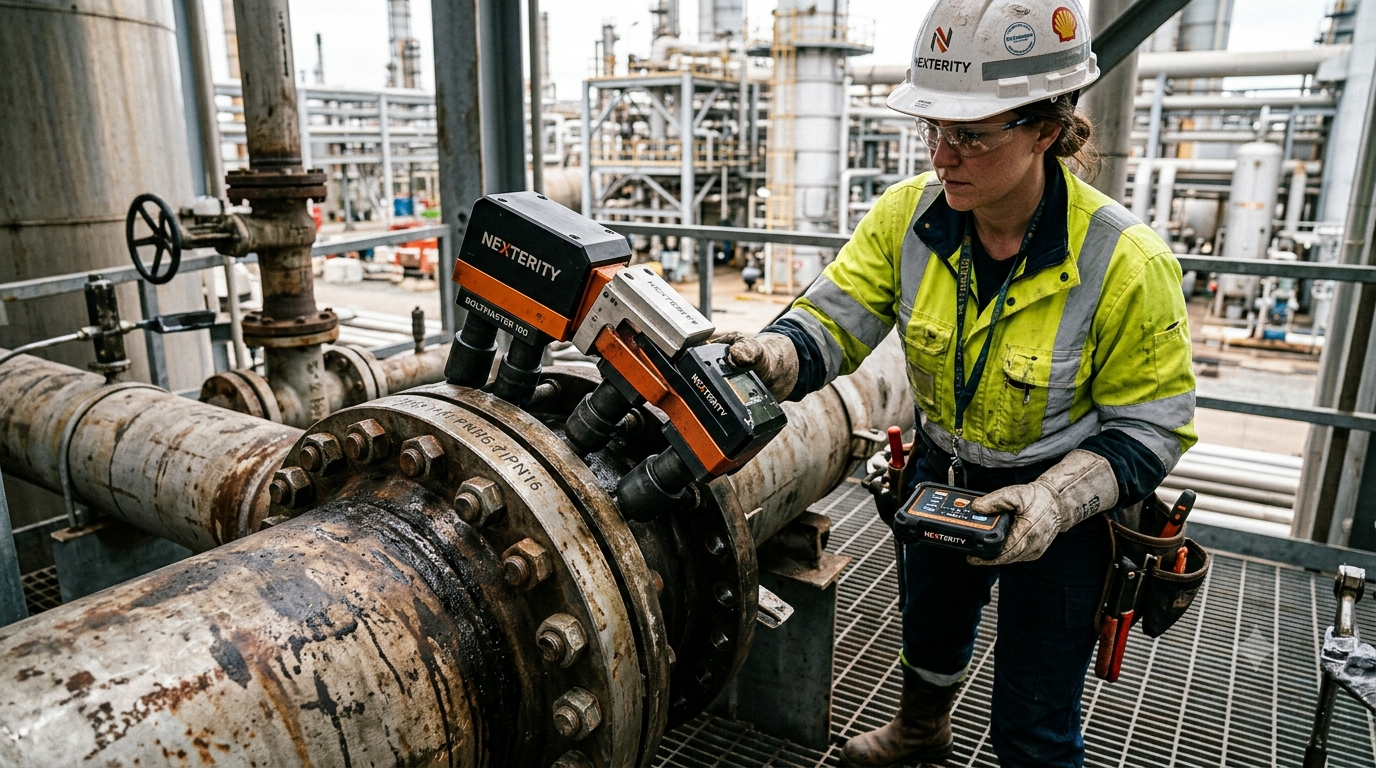
Nexterity, a startup founded by former ExxonMobil engineer and planner Lindsey Elliott, is developing a robotic system designed to automate this repetitive and physically demanding part of pipefitting.
The company’s approach focuses on bolted flange joints, where sections of industrial piping are connected using multiple bolts. Tightening and loosening these connections can require significant physical effort, particularly during maintenance and construction work.
Turning a Repetitive Task Into an Automation Opportunity
Pipefitters working in industries such as oil and gas can spend long hours performing physically intensive tasks. Extended shifts and repeated manual bolting can contribute to worker fatigue and injuries.
Elliott says conversations with pipefitters across the United States and Canada helped highlight the productivity and workforce challenges facing the industry.
Nexterity’s answer is a remotely controlled robot designed to take over some of the most strenuous bolting operations.
Rather than replacing an entire pipefitting workflow, the system focuses on one specific task that occurs repeatedly across industrial sites.
How Nexterity’s Robot Works
The robot consists of two main sections that attach around a pipe. Once secured, the battery-powered machine can travel along the pipe and operate multiple bolts.
The system is designed to loosen or tighten four bolts simultaneously, potentially reducing the amount of manual effort required from workers.
Nexterity has developed different configurations to accommodate various standard pipe sizes. Despite the industrial capabilities, the units are designed to remain portable enough for a single worker to transport.
The equipment can reportedly fit inside a Pelican case, allowing it to be moved between job sites without requiring specialized transportation.
That portability is important because Nexterity is considering a business model similar to construction-equipment rental. Instead of permanently installing the technology at one facility, the robots could be deployed where and when they are needed.
Why Standardization Makes Automation Possible
One of the interesting aspects of Nexterity’s strategy is its focus on a relatively standardized part of industrial piping.
According to Elliott, discussions with engineers and specialists in the pressure-vessel and piping industry helped identify a large concentration of commonly used pipe sizes.
A significant share of industrial pipes reportedly falls within the NPS2 to NPS8 range, meaning pipes with nominal sizes from two to eight inches.
That level of repetition creates an attractive environment for automation.
When the same task is performed repeatedly under similar physical conditions, robotic equipment can potentially be designed around predictable dimensions and movements.
More Than an Oil and Gas Technology
Although the concept has strong connections to oil, gas, and petrochemical infrastructure, Nexterity sees a much wider market.
Industrial piping systems are found across numerous sectors, including water and wastewater treatment, food and beverage production, mining, nuclear facilities, and manufacturing operations.
Emerging industries focused on sustainable and green manufacturing also require extensive piping infrastructure.
This means a solution designed around industrial bolting could potentially have applications far beyond traditional energy facilities.
Addressing Workforce and Safety Challenges
Automation in skilled trades is increasingly being explored as companies deal with workforce shortages and demanding working conditions.
Nexterity’s system is positioned around two potential benefits: reducing the physical burden placed on workers and improving productivity.
The goal is not necessarily to eliminate the pipefitter’s role. Instead, robotic equipment can handle repetitive or physically demanding operations while workers supervise the process and focus on tasks requiring experience, judgment, and technical expertise.
A Practical Approach to Industrial Robotics
Nexterity’s concept demonstrates how automation does not always have to involve highly complex humanoid robots or completely autonomous factories.
Sometimes the opportunity lies in identifying one repetitive, difficult task and building a machine specifically for it.
By focusing on a common industrial operation, standard pipe dimensions, portability, and remote control, Nexterity is developing a targeted approach to robotics for the trades.
If adopted at scale, technologies like this could become another tool for industrial workers, helping companies address labor challenges while making physically demanding jobs safer and more manageable.