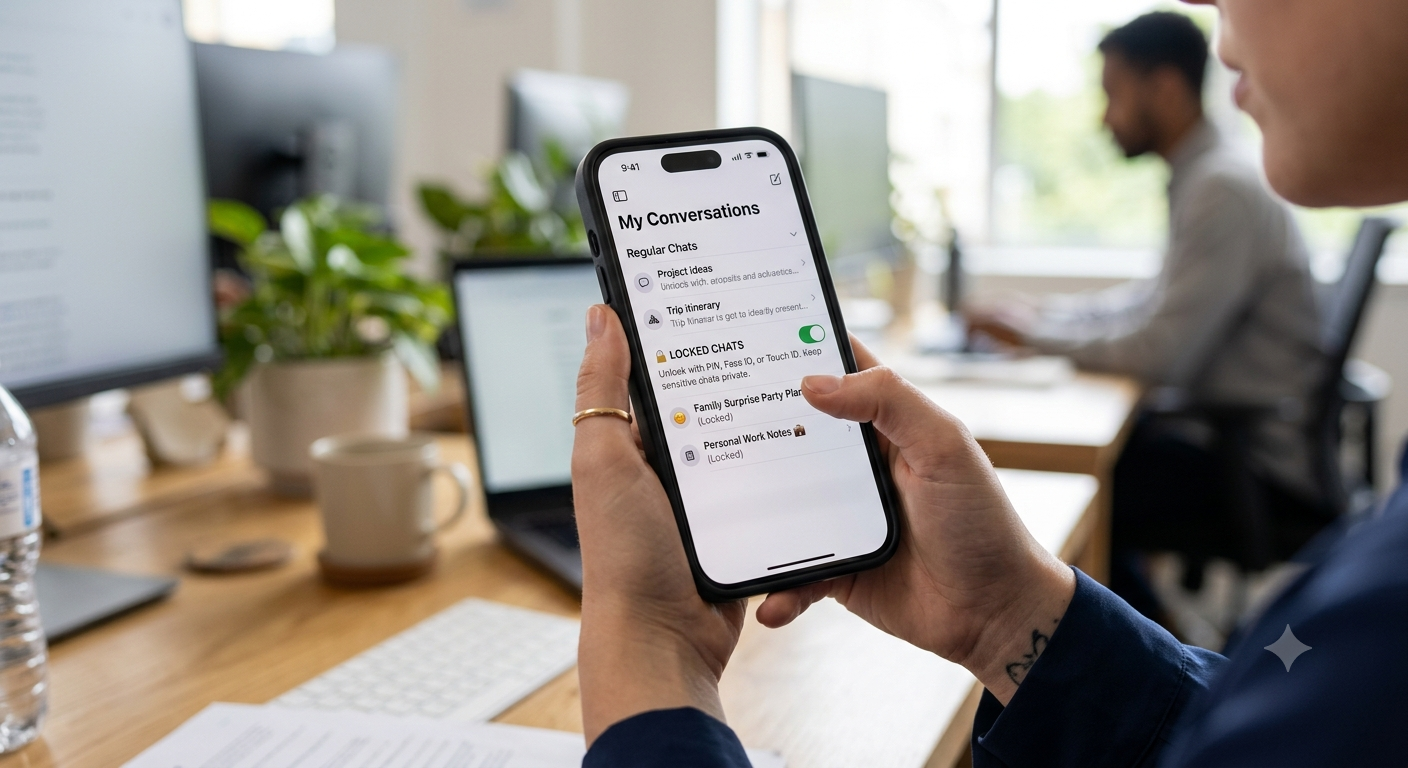
OpenAI is introducing a new privacy feature that allows ChatGPT users to lock individual conversations, giving them greater control over who can access personal discussions on their devices. The update is designed for situations where users may want to keep certain chats private while allowing friends, family members, or colleagues to use their devices.
The feature adds another layer of access protection as ChatGPT becomes a tool for everyday tasks, personal questions, professional work, and sensitive conversations.
How ChatGPT’s New Locked Chats Feature Works
According to OpenAI’s announcement on October 20, 2026, users can protect selected conversations using a four-digit PIN or biometric authentication, such as Face ID or Touch ID, on supported devices.
Once a conversation is locked, it moves into a dedicated Locked Chats section, separate from the regular conversation history. Locked conversations also remain hidden from standard chat search results and pinned conversations.
This organization makes it easier for users to separate private discussions from their everyday interactions without having to delete conversations they may want to revisit later.
For example, someone planning a surprise celebration, discussing a personal matter, or working through confidential notes may prefer to keep that conversation protected while showing another ChatGPT conversation to someone nearby.
Locked Chats Versus Temporary Chats
ChatGPT already offers Temporary Chats, which provide a separate conversation experience that does not appear in the regular chat history. Locked Chats serve a different purpose.
With locked conversations, users can return to their protected discussions whenever needed, rather than treating them as temporary sessions.
This distinction gives users more flexibility. Temporary Chats are useful when users want a conversation outside their normal chat history, while Locked Chats are intended for discussions they want to retain but protect from casual access by others using the same device.
What the New Privacy Feature Does Not Protect
Although chat locking adds a useful security layer, users should understand its limitations.
OpenAI states that locking a conversation does not create end-to-end encryption or place the chat inside a separate encrypted vault. It also does not change the company’s data-retention practices or remove information that ChatGPT may already have remembered before the conversation was locked.
The feature does not automatically change the user’s “Improve the model for everyone” data setting either.
Therefore, users should not interpret chat locking as a guarantee that their information is inaccessible to the service itself or exempt from its existing data-handling policies.
Anyone discussing highly sensitive information should review their privacy settings and understand how their conversations and data are handled.
A Separate Memory Space for Locked Conversations
The update also introduces a distinction between the memory associated with locked chats and regular ChatGPT memory.
When Memory is enabled, Locked Chats can maintain a separate memory shared among conversations within that protected section. New messages in locked conversations may contribute to this separate memory without updating regular Memory.
This separation is intended to prevent information introduced in locked discussions from carrying over into ordinary conversations through the regular memory system.
OpenAI also warns that resetting the PIN permanently deletes the locked chats and their associated files and other protected content. Users should therefore exercise caution before resetting their access credentials.
Which Conversations Can Be Locked?
Not every ChatGPT conversation supports the new feature. According to OpenAI, Locked Chats cannot be used with Temporary Chats, archived conversations, group chats, conversations created through shared links, chats involving scheduled tasks, or chats containing meeting recordings.
The feature is being rolled out across ChatGPT Free, Go, Plus, Pro, Business, Enterprise, and Edu plans. It is not available on ChatGPT for Healthcare, and access may take time to appear for all eligible users.
What This Means for ChatGPT Users
The introduction of Locked Chats reflects the growing importance of privacy controls in AI-powered applications. As people increasingly use ChatGPT for both professional and personal purposes, the ability to restrict casual access to individual conversations can be a valuable addition.
However, chat locking should be viewed as an access-control feature rather than a complete data-security solution. Users still need to manage their privacy settings carefully and avoid assuming that a protected conversation has different storage or retention rules.
Ultimately, the feature offers a more convenient way to keep selected conversations private on a shared or accessible device while preserving the ability to return to them later.