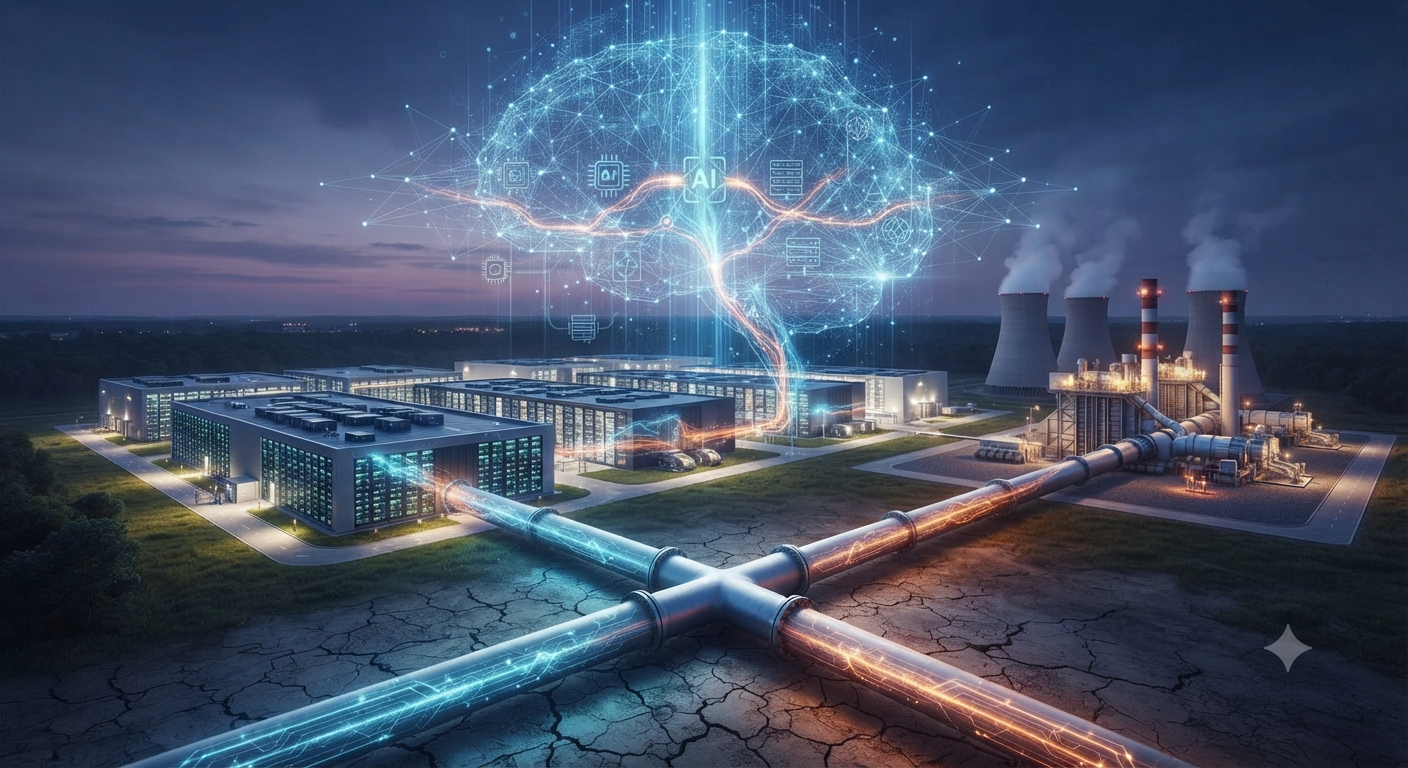
America’s rapid expansion of artificial intelligence infrastructure could have a major consequence beyond faster AI models: a dramatic increase in natural gas consumption.
By 2035, U.S. data centers could consume around 18 billion cubic feet of natural gas every day, according to a new BloombergNEF forecast. That’s nearly twice the level the organization projected only nine months earlier.
If that forecast materializes, data centers could eventually consume more natural gas than Germany and Japan combined, illustrating just how energy-intensive the AI infrastructure race is becoming.
Data Centers Are Emerging as a Major Gas Consumer
Over the next decade, data centers are expected to become the second-largest source of growth in U.S. natural gas demand, behind liquefied natural gas exports.
The remarkable part is that the latest projection already assumes that some of the many announced data center projects won’t actually be completed.
AI infrastructure requires enormous amounts of electricity, particularly for facilities packed with high-performance GPUs and other computing hardware. As technology companies race to secure dependable power for these facilities, natural gas is increasingly becoming part of their energy strategy.
Big Tech Is Looking Beyond the Traditional Grid
Some technology companies aren’t waiting for utilities to build enough generation and transmission capacity.
Meta, Microsoft, Google, and Amazon have all been associated with plans for new natural gas generation supporting data center expansion, including projects designed to produce electricity onsite rather than depending entirely on the existing grid.
BloombergNEF estimates that onsite-powered data centers alone could require roughly 2.9 billion to 3.4 billion cubic feet of natural gas per day by 2035.
That’s approximately comparable to the amount currently consumed by all U.S. data centers when gas burned to generate grid electricity is included.
Yet onsite generation may represent only a relatively small portion of what’s coming.
Grid-Connected Facilities Could Drive Even More Demand
Data centers connected to the electrical grid could have an even greater impact.
By the middle of the next decade, BloombergNEF projects that these facilities could indirectly drive an additional 15 billion cubic feet per day of natural gas consumption within the power sector.
To understand the scale, the forecast suggests that data centers could create roughly five times as much additional gas demand through 2035 as all other grid-connected sectors combined.
Such rapid growth could reshape both the electricity and natural gas markets.
Could Natural Gas Prices Rise?
Much of the current data center construction boom has taken place during a period of relatively stable natural gas prices.
That assumption may not hold forever.
Data centers aren’t the only source of growing demand. The U.S. is simultaneously expanding LNG exports, placing additional pressure on domestic natural gas supplies.
Analysts have warned that the combination of AI infrastructure and LNG demand could push gas prices significantly higher.
Large technology companies may have the financial capacity to absorb higher energy expenses. The bigger concern is what happens to households and businesses whose electricity rates are influenced by the same fuel costs.
If utilities must purchase more expensive natural gas to satisfy rapidly increasing power demand, consumers could ultimately feel some of that pressure through their electricity bills.
AI’s Climate Footprint Could Grow Too
The environmental consequences could be substantial.
The International Energy Agency estimates that burning and supplying one cubic foot of natural gas is associated with roughly 60 grams of carbon-dioxide-equivalent emissions, including emissions related to extraction, processing, and distribution.
Based on the demand levels described in the forecast, additional natural gas consumption associated with data centers could produce around 1 million metric tons of greenhouse gas emissions per day.
According to the article’s comparison, that’s equivalent to roughly 12% of current total U.S. greenhouse gas emissions.
AI’s Next Bottleneck May Be Energy
The AI race is often discussed in terms of chips, models, data, and computing capacity.
But increasingly, the decisive resource may be energy.
As companies build larger data centers, securing reliable electricity will become just as important as acquiring the latest GPUs.
Natural gas offers dependable power, but relying heavily on it introduces new economic and environmental trade-offs.
The next chapter of the AI boom, therefore, may not be determined only inside data centers.
It could also be determined by whether America’s energy infrastructure can affordably — and sustainably — keep them running.