A $70 million raise reframes the smart ring as a compute platform rather than a health tracker.
Ultrahuman’s rings have sold roughly 800,000 units on the promise of sleep and heart-rate data. The Bengaluru company now says that framing is the ceiling, not the product. Founder and CEO Mohit Kumar puts it bluntly: every ring on the market today is a tracker. He wants one that behaves like a computer.
The $70 million round — $65 million equity, $5 million debt — values Ultrahuman at $365 million, roughly triple its 2023 mark of $120 million. Qualcomm Ventures joined, as did Labcorp, Alpha Wave, Blume Ventures, Nexus Venture Partners, and Alteria Capital. Two of those names signal where this is heading.
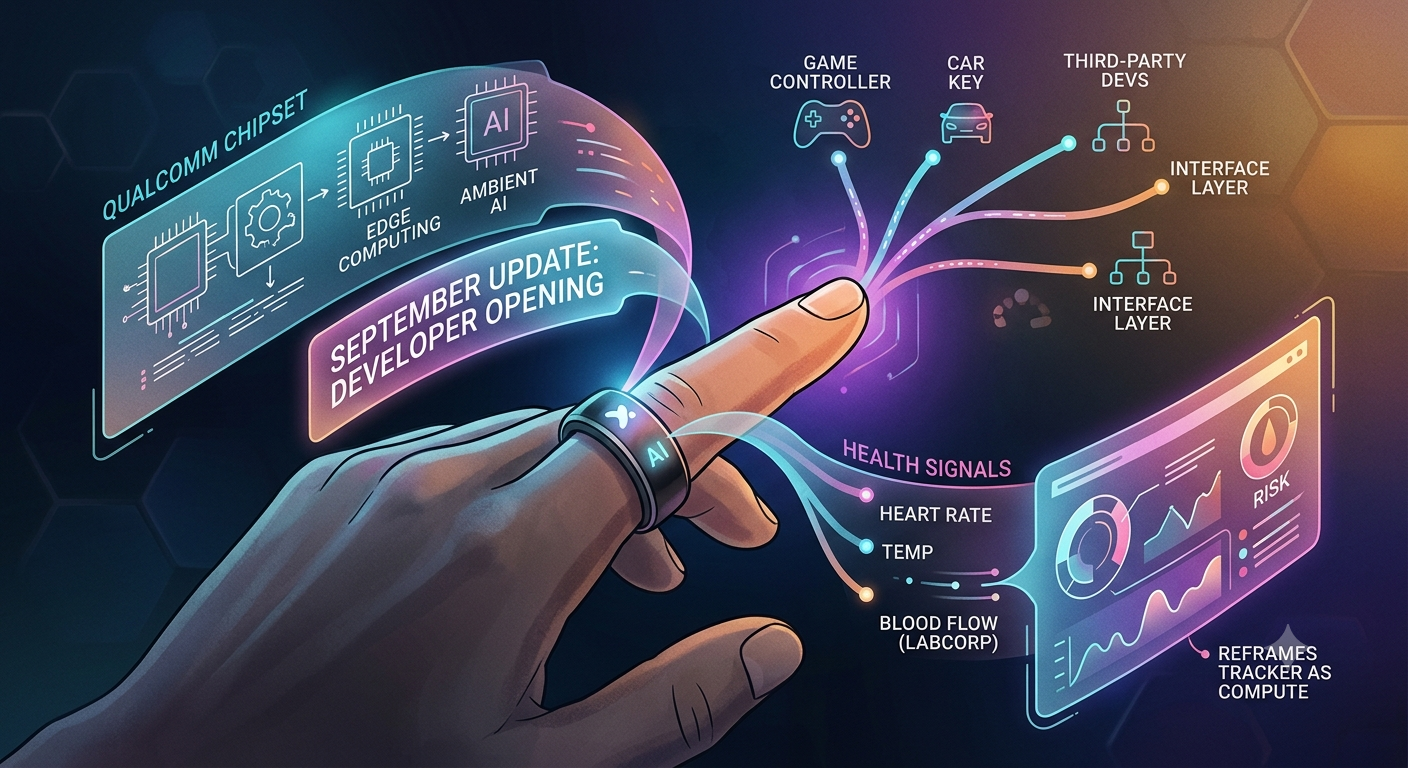
Ultrahuman is building a ring on Qualcomm silicon, while keeping Nordic Semiconductor chips in its current lineup. More onboard compute means algorithms run on the finger instead of round-tripping to a phone or the cloud. Quinn Li, who leads Qualcomm Ventures globally, described the bet as personal AI devices — ambient, always on.
The hardware is later. The software starts sooner. A September update to Ring Air and Ring Pro will open the devices to third-party developers and add game-controller and AI-interaction features. Kumar is also exploring the ring as a pointer, a car key, and an interface layer.
His argument for the form factor is positional. A smartwatch is a phone strapped to your wrist. A ring sits where your hand does precise work, and it carries physiological context nothing else does. A controller that knows your heart rate and body temperature can drive a game that responds to how tense you actually are.
The core business is running hot enough to pay for the detour:
- Revenue run rate: $140 million annually, up about 45% year over year
- Forward target: $200 million run rate by January 2027
- Subscription attach: 12% of users pay for PowerPlugs software features
- US demand: 18–20x available supply for the new Ring Pro
The US contributes about 45% of revenue, India roughly 11%. That US number is a recovery, not a plateau — a patent fight with Oura pulled Ring Air off shelves for much of the past year, and the redesigned Ring Pro brought the company back. Kumar expects previous volumes to return next quarter and to triple over the four after that.
Profitability is the tradeoff. Spending on retail locations, brand, and clinical studies may push Ultrahuman into the red this year. An IPO sits at 2028 at the earliest; Kumar wants eight quarters of profit on the board first. Oura, meanwhile, is reportedly circling a September listing.
The Labcorp thread matters too. The two are testing whether blood-flow signals from the ring, paired with lab bloodwork, can flag cardiovascular, fertility, and aging risks.
If rings become programmable, wearable data stops being a closed loop between one vendor and one app. Anyone planning health, fitness, or ambient AI products should treat the September developer opening as a real distribution question: is a finger-worn device a channel you want to build for, or one your competitor gets to first? The answer changes your 2027 roadmap, not your 2029 one.